
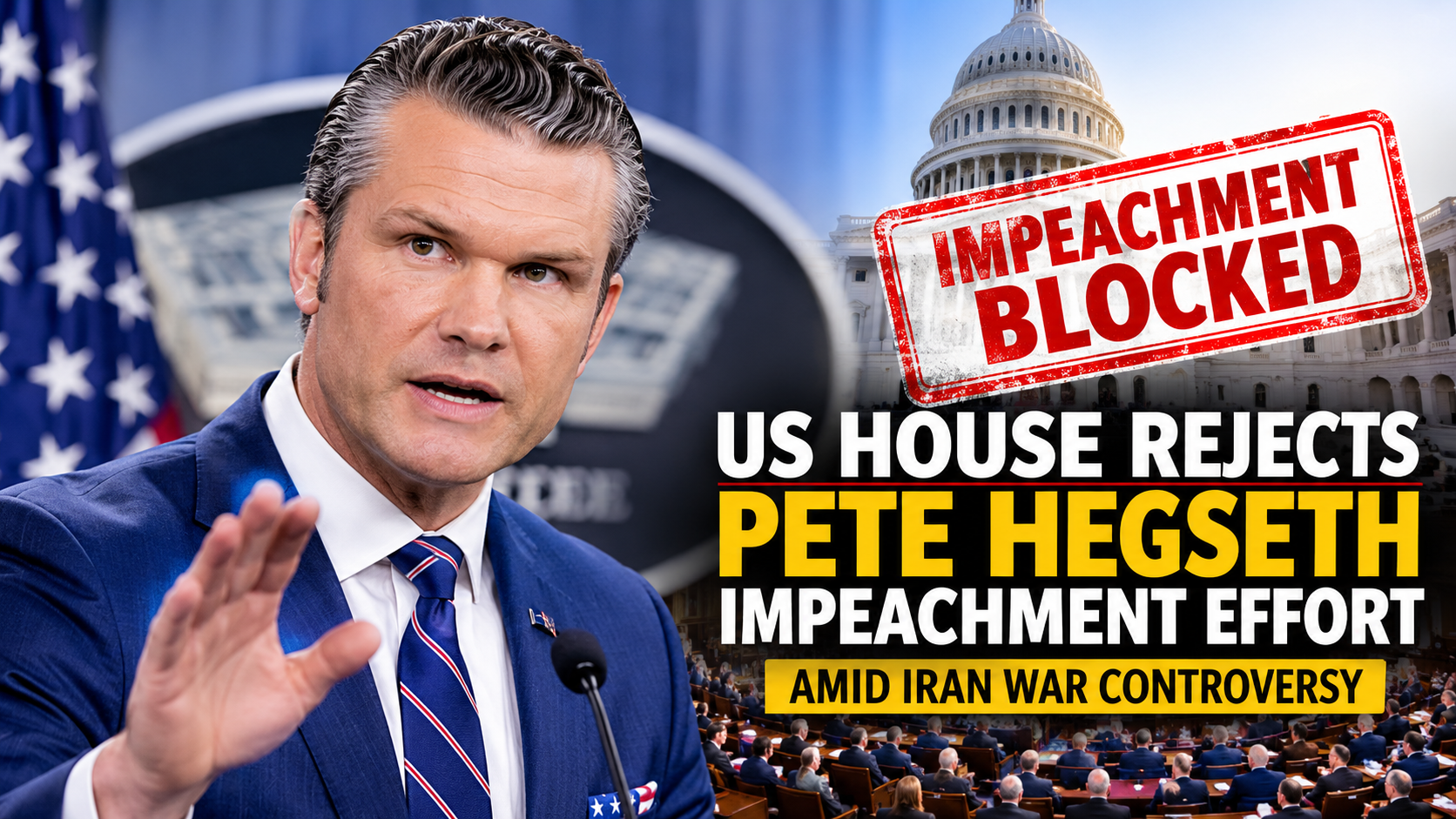
The US House of Representatives has blocked an effort to impeach Defence Secretary Pete Hegseth, giving President Donald Trump a political victory amid growing controversy over the administration’s handling of the war in Iran. Lawmakers voted 211-204 on November 10 to refer the impeachment resolution to the House Judiciary Committee, effectively preventing an immediate vote on the charges.
The resolution was introduced by Republican Representative Thomas Massie of Kentucky and supported by Democrats. It contained eight articles of impeachment accusing Hegseth of misconduct connected to US military operations, including the conflict with Iran. The House vote did not determine whether the allegations were valid, but instead sent the resolution to committee, effectively halting the immediate impeachment push.
US House Blocks Pete Hegseth Impeachment Resolution
The November 10 vote followed an increasingly contentious debate over Hegseth’s leadership at the Pentagon and the legal authority behind US military operations. According to the official House roll-call record, 211 members voted in favour of referring the resolution to committee, while 204 opposed the motion. Eighteen lawmakers did not vote.
The result largely followed party lines. A total of 210 Republicans supported the referral motion, while one Republican opposed it. All 203 Democrats who voted opposed the referral. One independent lawmaker supported the motion. Representative Massie was the only Republican to vote against sending his resolution to committee.
The procedural decision effectively stopped the impeachment resolution from advancing towards an immediate full House vote. It is important to distinguish this outcome from an acquittal: lawmakers did not vote on whether Hegseth was guilty or innocent of the allegations.

Why Was Pete Hegseth Facing Impeachment?
Thomas Massie’s impeachment resolution focused on what he described as serious violations involving Hegseth’s handling of US military operations and his responsibilities as head of the Pentagon. The eight articles largely centred on the Iran war, although they also addressed military actions in Yemen and Venezuela and other controversial decisions.
Massie argued that Hegseth had knowingly carried out unlawful orders and failed to uphold legal restrictions governing military action. The Kentucky Republican also raised concerns about the administration’s approach to congressional oversight and the accountability of senior military officials.
Among the issues highlighted in the resolution were reported reductions in staffing and resources at a Pentagon office responsible for mitigating civilian harm. Those changes preceded a US missile strike on an Iranian primary school during the conflict, which reportedly killed as many as 168 people. The allegations and circumstances surrounding the strike formed part of the broader debate over civilian protection during military operations.
Another count concerned the administration’s attempt to punish Democratic Senator Mark Kelly, a retired Navy pilot, after he participated in a video urging military personnel to refuse unlawful orders. Massie also questioned US strikes on alleged drug-smuggling boats in Latin America and the handling of survivors following those operations.
These allegations formed the basis of Massie’s impeachment initiative. However, they remained allegations rather than findings established through an impeachment trial.
Iran War at the Centre of the Impeachment Controversy
The conflict with Iran became the central issue behind the impeachment effort. Massie argued that the administration had continued military hostilities without the necessary congressional authorisation. He cited the War Powers Resolution, which generally requires the withdrawal of US forces from hostilities within 60 days unless Congress authorises continued military action or an applicable extension is invoked.
According to Massie’s public argument, the conflict had continued for 256 days without congressional authorisation. He maintained that the administration’s approach raised serious constitutional questions about the balance of power between the president and Congress.
Hegseth rejected the accusations and described the impeachment initiative as politically motivated. During a Pentagon news conference on November 10, he argued that the resolution was an attack on American military personnel and civilian leadership rather than a legitimate effort to address misconduct.
He also argued that the concerns raised by Massie represented policy disagreements rather than the kind of serious wrongdoing required for impeachment. Hegseth maintained that the military operations under his leadership were lawful.
Donald Trump Backs Pete Hegseth
President Donald Trump strongly defended Hegseth as the impeachment effort gained attention in Washington. Trump praised the Defence Secretary’s performance during the Pentagon briefing and later celebrated the House decision to refer the resolution to committee.
Trump described Hegseth as a strong member of his administration and criticised Massie, portraying the impeachment effort as an attempt by a disgruntled political opponent to undermine the administration.
Vice President JD Vance also rejected the initiative. In a public statement, Vance characterised the impeachment effort as a political spectacle that distracted from substantive policymaking. His comments reflected the administration’s position that disagreements over military strategy should be addressed through congressional oversight rather than impeachment.
The administration’s support was also reflected in a November 10 Statement of Administration Policy opposing the resolution and urging lawmakers to support the motion to refer it to committee.
What Did Democrats Say About Hegseth’s Leadership?
Democratic leaders supported the impeachment effort, arguing that Hegseth’s conduct raised serious questions about national security and the administration’s handling of military operations.
House Democratic leader Hakeem Jeffries backed the resolution and accused Hegseth of abusing his authority and undermining American national security. Jeffries is expected to become Speaker of the House when Democrats assume control in January, according to the reporting available at the time of the vote.
Senate Democratic leader Chuck Schumer also endorsed the impeachment effort. Their support demonstrated that opposition to Hegseth’s leadership extended beyond Massie’s Republican criticism and had become a broader political dispute between the administration and congressional Democrats.
However, the near party-line procedural vote demonstrated that Republican lawmakers were unwilling to advance the impeachment effort at that stage, despite some members expressing criticism of the Defence Secretary.
What Happens Next for Pete Hegseth?
The House decision effectively halted the immediate impeachment initiative against Hegseth during the current congressional session. The referral did not resolve the underlying allegations, and it did not prevent lawmakers from continuing to examine the Pentagon’s decisions through other oversight mechanisms.
The political situation could become more complicated in January, when Democrats are expected to take control of both chambers of Congress following the midterm elections, according to the Associated Press report. A change in congressional leadership could create new opportunities for hearings, investigations and renewed political pressure on the administration.
Nevertheless, any future impeachment initiative would face its own procedural and political challenges. The House would need to approve articles of impeachment before a Senate trial could take place. The November 10 vote did not bring the process to that stage.
What the Impeachment Vote Means for US Politics
The decision to block an immediate impeachment vote represents a short-term political victory for Trump and his Defence Secretary. It also highlights the growing divisions in Washington over military authority, congressional oversight and the administration’s strategy in the Middle East.
For Republicans, the vote demonstrated the party’s willingness to stand behind Hegseth despite criticism surrounding the Iran war. For Democrats, the result leaves unresolved questions about the legal and political accountability of the administration’s military decisions.
The wider debate is unlikely to disappear simply because the House referred the resolution to committee. Questions surrounding the War Powers Resolution, civilian casualties, military accountability and congressional authorisation will remain important issues as the Iran conflict and its political consequences continue to develop.
For now, Pete Hegseth has avoided an immediate impeachment vote. However, the controversy surrounding his leadership at the Pentagon remains a significant challenge for the Trump administration.