
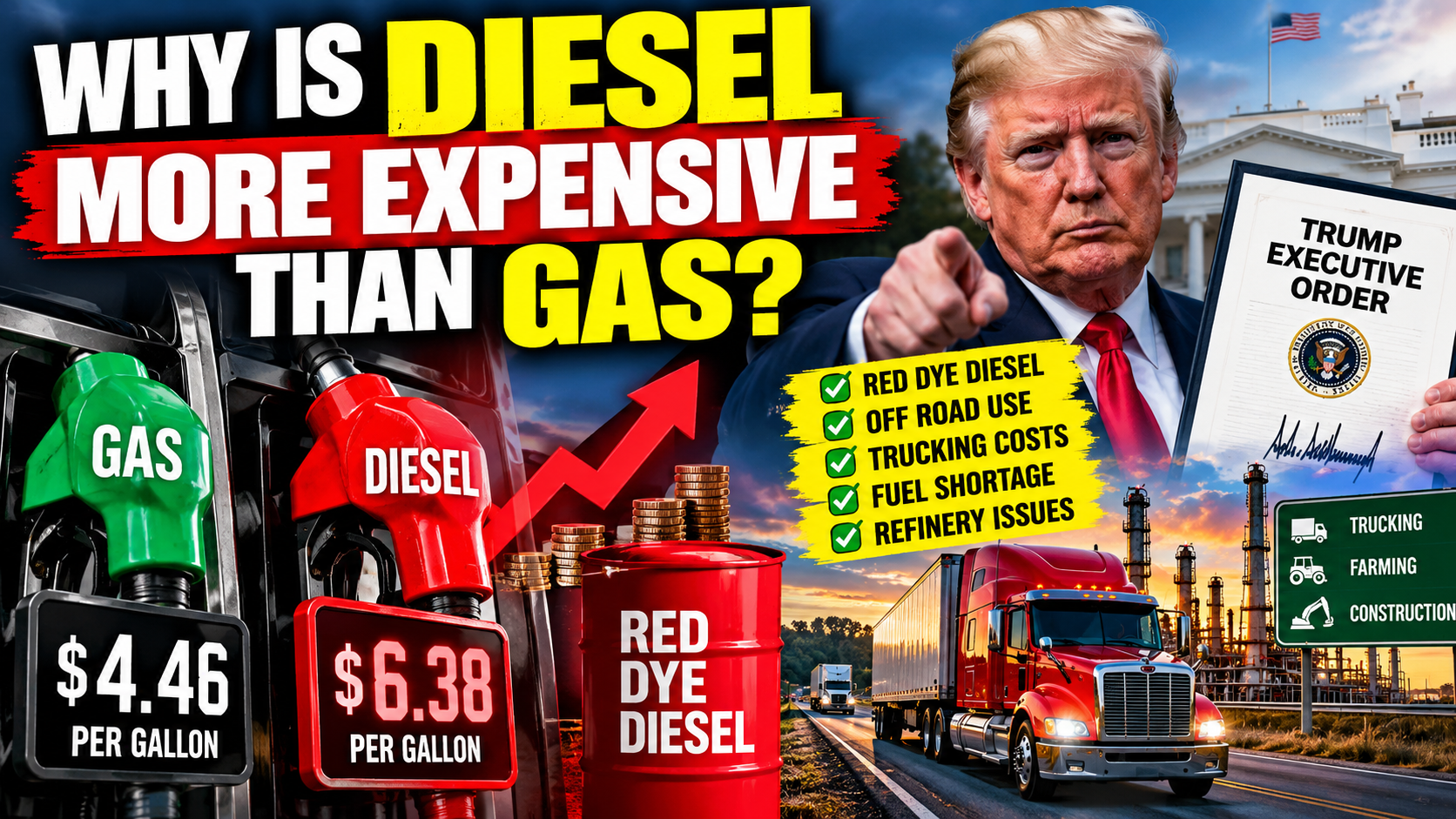
If filling a truck with diesel has suddenly become a much bigger expense, there is a reason. Diesel prices in the United States have risen sharply as global supplies of distillate fuels have tightened, refinery capacity has been disrupted and demand for diesel remains strong.
The difference is visible at the pump. In the week ending September 28, 2026, the U.S. average price for on-highway diesel was $6.382 per gallon, compared with $4.465 per gallon for regular gasoline.
The problem goes beyond drivers. Higher diesel costs affect trucking, farming, construction and the wider cost of moving goods.
The situation has also triggered new action from the Trump administration. On October 5, 2026, President Donald Trump signed an executive order providing temporary federal relief related to dyed diesel used on highways.
So, why is diesel more expensive than gas, and can the latest policy actually bring those costs down?
Red Dye Diesel Trump: What Is the New Diesel Relief About?
The phrase red dye diesel Trump refers to the administration’s October 5 action involving dyed diesel, commonly called red diesel.
Red-dyed diesel is generally intended for tax-exempt, off-road uses such as farming and certain construction or other equipment. The red dye makes the fuel identifiable and helps authorities distinguish it from diesel intended for highway use. Under normal federal rules, dyed diesel is not treated in the same way as taxable on-highway diesel.
The new executive order temporarily changes the enforcement and tax situation.
The White House order directs the Treasury Secretary to determine whether certain diesel-tax payment obligations incurred between October 5 and December 31, 2026 can be deferred without interest or penalties. It also directs the IRS not to impose specified dyed-fuel penalties when dyed diesel is sold for use or used on highways during that period, to the extent authorized by law.
That distinction matters. The order does not simply declare that every red-dyed diesel tax is permanently eliminated.
Trump Executive Order Diesel: What Does the Order Actually Change?
The Trump executive order diesel measure is primarily a temporary relief mechanism.
Under the order, the Treasury Department is instructed to examine whether federal law permits certain diesel excise-tax obligations to be deferred. The covered period runs from October 5 through December 31, 2026. If authorized, those deferred amounts would not accrue interest or penalties during the deferral period.
The order also addresses the use of dyed diesel on highways during the same period by directing the IRS not to impose certain penalties, subject to the legal authority described in the order.
The federal on-highway diesel tax is normally 24.40 cents per gallon, according to the U.S. Energy Information Administration. That is higher than the federal gasoline tax.
For truck operators buying large quantities of fuel, even a difference measured in cents per gallon can become meaningful.
However, the policy does not change the basic economics of global diesel supply. If refineries are short of distillate production or inventories remain low, the underlying market price can stay elevated even when taxes or penalties are temporarily reduced.
Red Diesel Executive Order: How Could It Affect Fuel Costs?
The red diesel executive order could provide short-term relief for eligible fuel users by reducing the immediate tax burden associated with highway use of dyed diesel.
The White House says the federal diesel tax is 24.4 cents per gallon and estimates that this could represent roughly $60 on a 250-gallon fill. Where states take corresponding action, the White House says savings could exceed $100 per fill.
But the distinction between tax relief and lower wholesale fuel prices is important.
A truck operator’s final fuel bill reflects much more than federal tax. EIA says diesel prices are affected by crude oil costs, refinery processing, distribution, retail margins, taxes and the diesel crack spread, which is an indicator of refining margins.
That means the executive order can potentially reduce one part of the bill without solving the global supply problem.
Red Dye Diesel Executive Order: Why Is Red Diesel Normally Restricted?
The red dye diesel executive order is significant because dyed diesel normally has a different tax treatment from highway diesel.
The IRS explains that diesel intended for nontaxable purposes, including certain farming uses, can be dyed and sold without the regular federal excise tax being imposed at the same stage. The dye is added specifically so the fuel can be identified.
Under normal rules, using dyed fuel for a taxable highway purpose can result in penalties. The IRS states that the penalty can include the greater of $1,000 or $10 per gallon of dyed fuel involved, in addition to any applicable tax.
The October 5 executive order creates a temporary emergency framework around those rules. It directs the IRS not to impose specified penalties for dyed diesel sold for use or used on highways during the October 5-December 31 period, subject to the order’s legal conditions.
That is why the measure has attracted attention from trucking and agricultural users.
Trump Policy on Diesel Costs: Can It Make Diesel Cheaper?
The Trump policy on diesel costs can reduce some of the immediate financial pressure on truckers and farmers, but it cannot by itself manufacture additional diesel.
That is the key point.
EIA reported in September that global distillate supplies were tight because of reduced refining activity in Russia, China and the Middle East. At the same time, U.S. refineries were already operating at very high utilization rates. U.S. distillate production averaged 5.1 million barrels per day from January through August 2026, the highest level since 2019, while refinery utilization reached 97% for the week ending September 11.
In other words, American refineries have been producing large quantities of diesel, but the global market is also demanding large quantities.
EIA also reported that U.S. distillate inventories were 13% below their five-year seasonal average as of September 11. Lower inventories can increase the value of available diesel and push refining margins higher.
This explains why simply lowering a tax does not necessarily cause the underlying market price to fall.
Off Road Diesel Executive Order: Who Can Benefit?
The off road diesel executive order is particularly relevant to farmers and other users who already depend heavily on dyed diesel.
Agricultural machinery, construction equipment and other off-road equipment can traditionally use dyed diesel for qualifying nontaxable purposes. The new order also directs the Agriculture Department to coordinate with agricultural cooperatives, rural fuel distributors and farm-supply organizations to help maintain access to dyed diesel in areas of high demand.
For truckers, the important change is the temporary federal treatment of dyed diesel for highway use.
However, users should not assume that every state will automatically apply identical rules. The executive order directs federal officials to engage with states and encourage corresponding state action, while also stating that implementation must remain consistent with applicable law.
That makes the state-level rules important for anyone considering the temporary relief.
Where to Buy Red Dye Diesel
The question of where to buy red dye diesel is especially relevant for farmers, construction operators and other users who qualify for tax-exempt off-road fuel.
Dyed diesel is typically distributed through agricultural fuel suppliers, rural fuel distributors and other businesses serving off-road equipment. The exact availability depends on location and local fuel distribution networks.
The important point is that buying red-dyed diesel and using it are two separate issues.
Under normal rules, dyed diesel is intended for qualifying nontaxable uses. The October 5 federal order created a temporary exception framework for highway use through December 31, 2026, but the practical application can depend on federal implementation and corresponding state action.
Anyone purchasing or using dyed diesel should therefore check the rules applicable to the state and type of use rather than assuming that the federal announcement automatically overrides every state requirement.
Can I Use Red Diesel in My Truck?
Can I use red diesel in my truck? Under ordinary rules, the answer is generally no when the truck is being operated on public highways for a taxable use.
The red dye identifies fuel that has received special tax treatment. The IRS normally imposes penalties when dyed fuel is knowingly used for a purpose that is not tax-exempt.
The October 5, 2026 executive order is different because it establishes a temporary federal relief period.
The order directs the IRS not to impose certain penalties when dyed diesel is sold for use or used on highways from October 5 through December 31, 2026, subject to the authority and conditions set out in the order.
That does not mean truck operators should ignore all fuel regulations. The order specifically requires continued highway compliance enforcement, including audits, inspections and monitoring.
For that reason, truck owners and operators should verify the current federal and state requirements before changing the fuel they use.
Where Can I Buy Red Dye Diesel?
The question where can I buy red dye diesel has become more important as the fuel-price crisis has increased interest in lower-tax fuel.
For conventional off-road use, buyers can generally look to agricultural fuel distributors, farm-supply networks and other suppliers serving commercial equipment.
But price should not be the only consideration.
Buyers should confirm:
- Whether the supplier is authorized to sell dyed diesel for the intended use.
- Whether the fuel meets the specifications required for the equipment.
- Whether state rules impose additional requirements.
- Whether the temporary highway provisions apply to their specific situation.
- Whether the fuel purchase and use will be properly documented.
The federal government has specifically directed the Agriculture Department to work with rural fuel distributors and agricultural organizations to support dyed-diesel access in high-demand areas.
Diesel Prices US Trucking Industry: How Are High Diesel Prices Affecting Trucking?
The diesel prices US trucking industry issue goes far beyond what a driver pays at a fuel station.
Trucks consume large quantities of diesel, so a sharp increase in the per-gallon price can quickly raise operating costs. Those higher costs can then influence freight rates and the cost of transporting goods.
The current market shows why the pressure has been so strong. EIA’s September analysis found that tight global distillate supplies, elevated crude oil prices and high diesel crack spreads were pushing diesel prices higher.
U.S. diesel prices have also remained substantially above gasoline prices. For the week ending September 28, the national average was $6.382 per gallon for on-highway diesel versus $4.465 for regular gasoline.
There is another reason diesel can remain expensive even when crude oil prices begin to stabilize: refineries have to convert crude into usable products, and the availability of those finished products matters.
EIA’s September 2026 outlook said low distillate inventories were contributing to higher domestic diesel prices. It also expected seasonal refinery maintenance and higher fall and winter demand to add pressure to the market.
That is why the diesel problem cannot be explained simply by saying that crude oil is expensive.
The Bottom Line: Why Is Diesel More Expensive Than Gas?
So, why is diesel more expensive than gas?
There is no single reason.
Diesel prices are shaped by a combination of global demand, limited distillate supplies, refinery capacity, crude oil prices, refining margins, distribution costs and taxes. EIA notes that diesel has generally been more expensive than regular gasoline in the United States since September 2004, with strong global distillate demand, cleaner low-sulfur fuel requirements and the higher federal on-highway diesel tax among the factors behind the long-term difference.
The current 2026 crisis has added another layer. The IEA says the Middle East conflict has caused an unprecedented disruption to global fuel markets and has tightened supplies, prompting governments and the IEA itself to take emergency measures.
The Trump administration’s October 5 executive order could provide temporary relief for American farmers and truckers by deferring certain federal diesel-tax obligations and changing the penalty treatment for dyed diesel used on highways through the end of 2026.
But that is different from permanently making diesel cheap.
The bigger question remains whether global refining capacity, inventories and fuel flows can recover enough to ease the underlying shortage. Until that happens, tax relief may reduce part of the burden without eliminating the market forces keeping diesel prices above gasoline.
Keywords covered:
red dye diesel trump · trump executive order diesel · red diesel executive order · red dye diesel executive order · trump policy on diesel costs · off road diesel executive order · where to buy red dye diesel · can i use red diesel in my truck · where can i buy red dye diesel · diesel prices us trucking industry
