
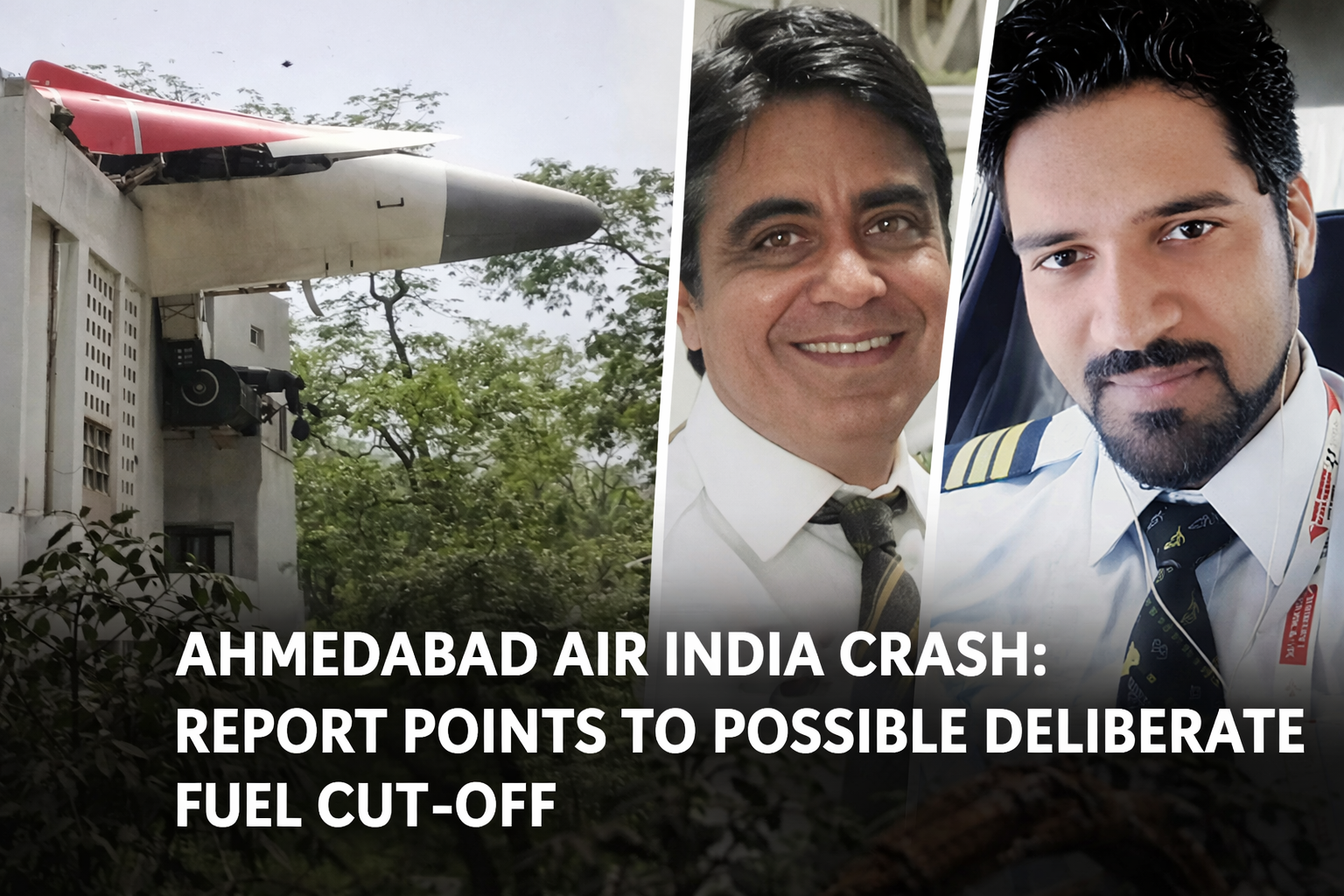
A new report has claimed that the Air India crash in Ahmedabad was not the result of a technical malfunction but may have occurred after the aircraft’s engine fuel control switch was deliberately turned off.
According to Italian daily Corriere della Sera, which cited two sources familiar with discussions between New Delhi and Washington, investigators have reached a preliminary conclusion that the June 12, 2025 crash followed an intentional action rather than mechanical failure. However, officials have cautioned that definitive findings should await the release of the Directorate General of Civil Aviation’s (DGCA) final report.
The Aircraft Accident Investigation Bureau (AAIB) had earlier released a preliminary assessment in July 2025, noting a critical cockpit exchange recorded shortly before the crash. In the cockpit voice recording, one pilot is heard asking, “Why did you turn the fuel off?” The other responds, “I did not do that.”

Investigators are now examining whether manual movement of the engine fuel control switch led to a loss of power. Black box data reportedly ruled out mechanical failure, instead indicating that the engines were shut down shortly before impact.
The Boeing 787 Dreamliner had taken off from Ahmedabad airport and crashed within seconds. The accident claimed 260 lives, including passengers and people inside a nearby medical students’ hostel struck by the aircraft. Only one passenger survived.
The report suggests that responsibility has not been formally established. It names Captain Sumeet Sabharwal, the pilot-in-command, as a central figure in the investigation, while First Officer Clive Kunder was serving as co-pilot. The newspaper also referenced claims that emerged after the crash regarding Sabharwal’s mental health, alleging he had been suffering from depression.
Following the preliminary findings, Sabharwal’s father publicly rejected the allegations and called for a fresh and impartial investigation. He dismissed speculation linking his son’s mental health to personal issues, including reports of marital difficulties.
Corriere della Sera further reported that the final investigation may include recommendations for enhanced psychological evaluations and continuous mental health monitoring of pilots.
In the weeks after the tragedy, multiple theories surfaced, ranging from technical malfunction to human error. As the investigation progressed, focus increasingly shifted to the cockpit fuel control system. Officials are now preparing a draft of the final report, which is expected to provide greater clarity on the sequence of events that led to one of the deadliest aviation disasters in recent years.