
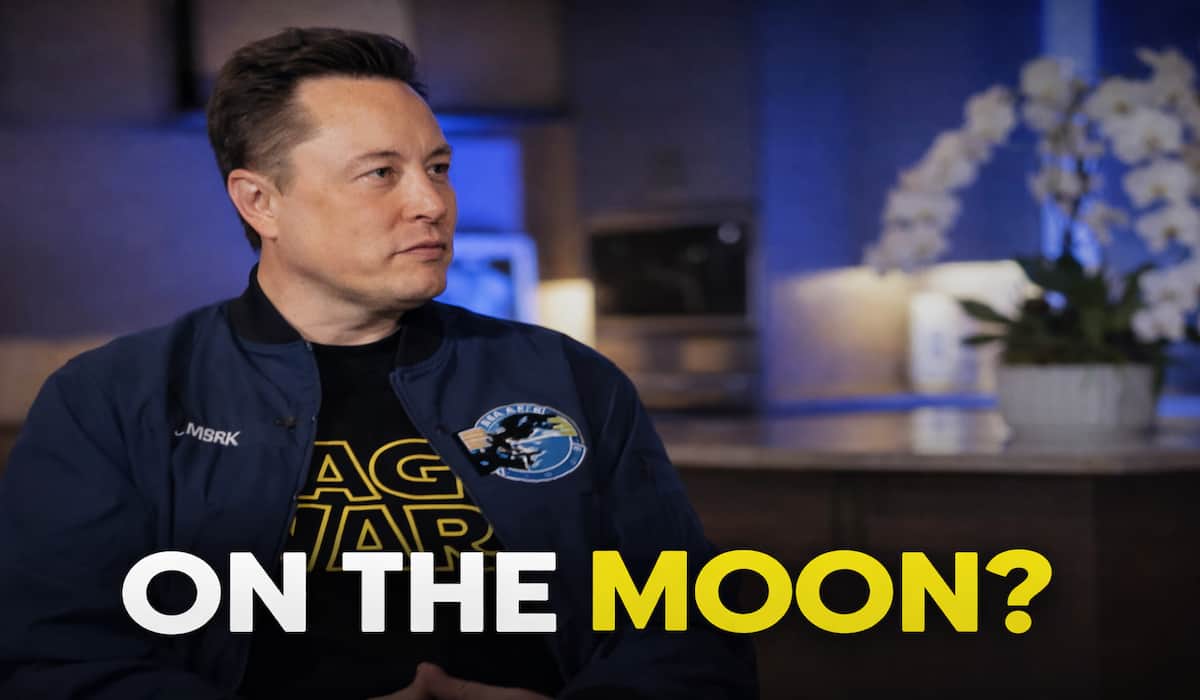
When asked—again—whether humans really went to the Moon, Elon Musk didn’t hedge.
“Yes, we went to the Moon a few times, actually,” he said in a recent interview. “We didn’t just go to the Moon—we actually got a little bored and started playing golf on the Moon.”
The line was delivered with Musk’s familiar dry humor. But behind it lies a body of evidence so extensive that, in science, it moves beyond belief and into verification.
Did humans really go to the Moon?
Between 1969 and 1972, NASA sent six successful crewed missions to the lunar surface as part of the Apollo missions. Twelve astronauts walked on the Moon. They left behind scientific instruments, collected nearly 382 kilograms of lunar rock, and returned data that is still studied today.
Independent observatories around the world tracked the missions in real time. Moon rocks brought back contain isotopic signatures unlike anything found on Earth. Even today, lasers are bounced off retroreflectors left on the Moon to measure the distance between Earth and its satellite with millimetre precision.
Science, in other words, did not move on because it was bored. It moved on because the evidence was settled.
Why going back now matters
Musk’s remark raises a deeper question: if we've already gone, why return?
The answer lies not in repeating history, but in extending it. The Moon is no longer seen as a destination for flags and footprints, but as a testing ground—close enough to Earth to resupply, yet hostile enough to prepare humanity for deeper space.
NASA’s current lunar push under the Artemis program aims to establish a sustained human presence. That means learning how to live, work, and survive on another world for months at a time.
The science of making life feasible on the Moon
Life on the Moon is not romantic. It is engineering.
The lunar surface has no breathable atmosphere, extreme temperature swings, and constant radiation exposure. Any long-term human presence depends on solving a few hard problems.
1. Radiation protection
Without Earth’s magnetic field, astronauts are exposed to cosmic radiation and solar storms. Proposed solutions include habitats buried under lunar soil, known as regolith, which can block harmful rays.
2. Water and oxygen extraction
Ice has been detected in permanently shadowed craters near the Moon’s poles. If extracted, this water can be split into oxygen for breathing and hydrogen for fuel. This concept—called in-situ resource utilization—reduces the need to launch everything from Earth.
3. Food production
Experiments have already shown that plants can grow in simulated lunar soil when supplemented with nutrients. Controlled hydroponic systems could allow astronauts to grow food inside sealed habitats.
4. Energy generation
Solar power is abundant on the Moon, especially near the poles, where sunlight can be nearly constant. Small nuclear reactors are also being studied as a stable power source during long lunar nights.
Musk’s role in the lunar future
While NASA leads public exploration, Musk’s company SpaceX is shaping how humans get there.
SpaceX’s Starship vehicle—designed to be fully reusable—is intended to carry large crews and cargo to the Moon and beyond. Under NASA contracts, Starship is being adapted as a lunar lander, capable of transporting astronauts from lunar orbit down to the surface.
For Musk, the Moon is not the end goal. It is a rehearsal.
His long-term vision focuses on Mars, but the Moon offers a nearby proving ground for technologies that must work perfectly before humanity attempts interplanetary settlement.
From disbelief to data
Moon landing denial has persisted largely because of distance—both physical and generational. Most people alive today did not witness the Apollo missions. But science does not depend on memory; it depends on reproducibility and evidence.
Every new lunar mission—robotic or human—adds to that evidence. Orbiters photograph landing sites. Instruments still respond decades later. International partners, from Europe to Asia, confirm the same results.
What was once an extraordinary claim has become routine science.
A stepping stone, not a myth
Musk’s offhand comment about golf on the Moon echoes a historical truth: once something is proven, curiosity moves forward. The Moon did not lose its importance—it gained a new role.
Today, it stands as humanity’s nearest laboratory for learning how to live beyond Earth. Not as a conspiracy to argue over, but as a challenge to prepare for.
If science has its way, the next time humans grow “bored” on the Moon, it may be because living there has become normal—and because the next destination is already waiting.
